How Long Should a Daily Yoga Flow Actually Be?
Quick Answer: Fifteen to twenty minutes is the sweet spot for a daily flow. It is long enough to move every major joint and change how you feel, and short enough to survive a bad week. Sixty-minute sessions are better workouts and worse habits, which is why most daily practices die in month two.
Almost everyone who quits a daily practice quits because of length, not because of the yoga. They set the bar at an hour, hit three days where an hour was never going to happen, and the streak breaks.

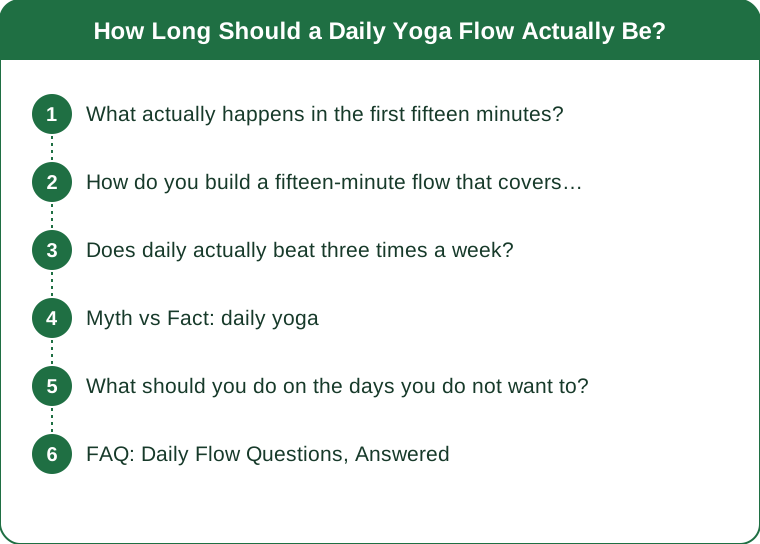
What actually happens in the first fifteen minutes?
More than most people expect, because the early minutes are where the biggest changes happen.
Minutes 0-3: joint fluid redistributes, synovial fluid warms, and range of motion starts opening. This is why the first downward dog always feels worse than the fourth.
Minutes 3-8: breathing rate settles and heart rate variability shifts. This is the part people describe as the mental change, and it is well underway before the halfway point of a short session.
Minutes 8-15: tissue temperature is up, and this is where you get real range — the deeper hip work, the twists that actually rotate, the backbends that do not feel like a negotiation.
What the next forty-five minutes add is depth, strength, and skill work. Those are real, but they are additions to a benefit curve that is already steep in the first quarter hour. If you are choosing between fifteen minutes daily and sixty minutes on Sunday, the fifteen wins on almost every measure that matters day to day.
How do you build a fifteen-minute flow that covers everything?
Cover the six movements of the spine and the three main hip actions. That is the whole checklist.
A structure that works:
- Two minutes standing — breath, arms overhead, gentle side bends. Wake the system.
- Three minutes cat-cow and thread the needle — flexion, extension, rotation for the spine.
- Four minutes sun salutation — two to three rounds at a pace that lets you breathe. This is the heat.
- Four minutes standing poses — warrior II, side angle, triangle. Hips open, legs load.
- Two minutes floor — a hip opener, a twist, a forward fold.
That is fifteen minutes and it misses nothing structurally important. Add time by extending step 3 and step 4, not by adding new categories.
The reason to keep the shape fixed is that decision-making is the real friction. A flow you can start without thinking is a flow you will start.
Does daily actually beat three times a week?
For habit strength, yes, and it is not close. For pure physical adaptation, the answer is more nuanced.
Daily wins on consistency. A practice that happens every day needs no scheduling decision. Three times a week requires you to pick which three, every week, forever — and that decision is where practices go to die.
Daily wins on mobility. Range of motion responds well to frequent, moderate exposure. Short daily sessions produce better flexibility outcomes than the same weekly volume in fewer, longer blocks.
Three times a week can win on strength. If your practice is a demanding power or ashtanga style, your tissues need recovery days. Daily hard practice is a recipe for wrist, shoulder, and hamstring problems.
The resolution most long-term practitioners land on: move every day, but vary the intensity. Two or three demanding sessions a week, and the rest short and gentle. That is daily practice in the way that actually lasts, and it is what almost every teacher does themselves.

Myth vs Fact: daily yoga
Myth: A short practice is not a real practice. Fact: Duration is one variable among several. A focused fifteen minutes with full attention does more for mobility and mood than an hour spent half-watching the clock.
Myth: You need to work up a sweat for it to count. Fact: Sweat measures thermoregulation, not benefit. Restorative practice produces measurable changes in autonomic state without any sweat at all.
Myth: Missing a day ruins the streak, so there is no point continuing. Fact: This is the single most destructive belief in habit formation. Research on habit consistency finds that one missed day has no measurable effect on habit strength. Two in a row starts to. Miss one, return the next day, and nothing is lost.
Myth: Morning is the correct time. Fact: Morning is a convenient time because nothing has happened yet to displace it. Evening practice has real advantages — the body is warmer, and range of motion is genuinely better. The best time is the one that repeats.
Myth: You should feel better after every session. Fact: Some sessions are flat and that is normal. The benefit is in the aggregate, not in each instance. Judging a practice by how good today felt is how people talk themselves out of it.
What should you do on the days you do not want to?
This is the question that actually determines whether a daily practice lasts a year, and the answer is to have a version so small it cannot be refused.
Define your floor in advance. Mine should be about three minutes: cat-cow, one downward dog, a forward fold, and child’s pose. That is the version for the day you got home at eleven.
The floor is not a failure state. It is the mechanism that keeps the identity intact. The person who did three minutes is still a person who practises daily. The person who skipped is renegotiating tomorrow from scratch.
Lower the barrier physically. Mat already unrolled. Same spot. No outfit requirement — practising in what you are already wearing removes a surprisingly effective excuse.
Late summer note: as evenings shorten through late August and September, an evening practice that relied on natural light starts happening in the dark. Move it earlier by a step, or accept the lamp and stop treating the change as a disruption. Most autumn practice collapses are a lighting problem misread as a motivation problem.
FAQ: Daily Flow Questions, Answered
Is it bad to do yoga every single day?
Not if you vary intensity. Daily gentle-to-moderate practice is well tolerated. Daily maximum-effort practice, especially with lots of weight-bearing on wrists and shoulders, tends to produce overuse problems within a few months.
Should I do the same sequence every day?
Mostly yes, with small variations. A fixed sequence removes decision friction and lets you notice actual changes in your body, because the reference point stays constant. Vary about 20% of it to prevent staleness.
How long before I notice anything?
Mood and sleep changes often show up within one to two weeks. Meaningful flexibility change takes six to eight weeks of consistent practice. If you are measuring by flexibility alone in week two, you will quit before the evidence arrives.
TL;DR:
- Fifteen to twenty minutes daily beats sixty minutes weekly for mobility, mood, and habit survival.
- Cover the six spinal movements plus hip work — a fixed fifteen-minute shape misses nothing structural.
- Move daily but vary intensity: two or three demanding sessions a week, the rest short and gentle.
- Define a three-minute floor version for bad days; missing one day changes nothing, missing two starts to.
- Fix the sequence to remove decision friction, and vary about a fifth of it to stay interested.
The practice that lasts is the one designed around your worst week, not your best one. Set the bar where a tired Tuesday can still clear it, and let the good days take care of themselves.
See It in Motion
Seen here: High Waist Printed Bootcut Yoga Pants with Pockets — shop it on bubblelime.com
Keep Reading
This article is for general informational purposes only and is not medical advice. It is not a substitute for professional diagnosis or treatment. Always consult a qualified healthcare provider about your individual situation, especially before making significant changes to your diet or exercise routine.