How to Build a 10-Minute Flow That Is Not Just a Shorter Class
Quick Answer: A ten-minute flow works when you pick one spinal direction and one hip action and build the whole sequence around them, instead of trying to touch every joint. Structure it as two minutes of joint prep, six minutes of a repeating three-to-five pose loop, two minutes of settling. The repeating loop is what makes it feel like practice rather than a rushed checklist — repetition is where the nervous system actually shifts.
You have ten minutes. So you find a ten-minute video, and it is a sixty-minute class with everything removed except the poses, delivered at speed.
You finish it feeling like you did something administrative.
The problem is not the length. It is that short sequences are usually designed by subtraction, and subtraction is the wrong operation.

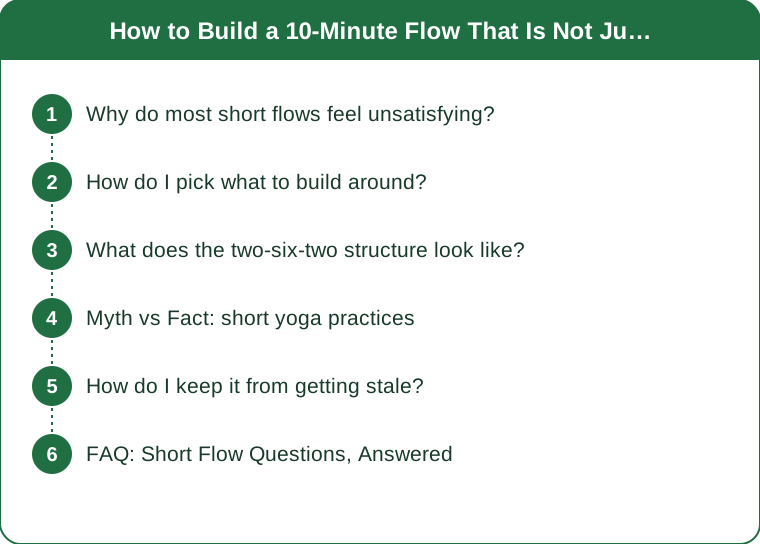
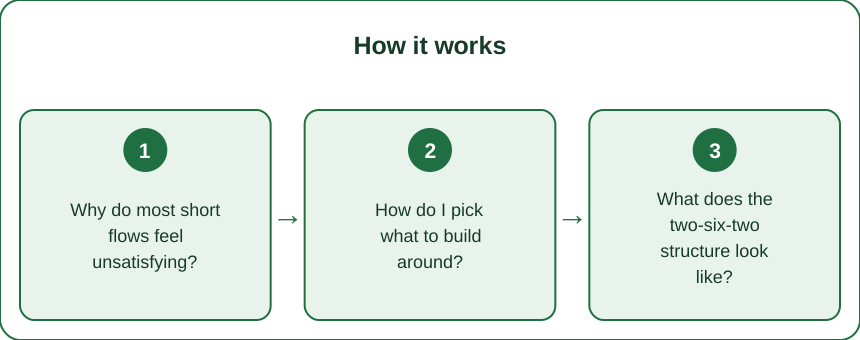
Why do most short flows feel unsatisfying?
Because they are built to reassure you that nothing was missed.
A standard class structure moves through a lot of territory: spinal warm-up, sun salutations, standing poses, balance, hip openers, twists, backbends, forward folds, closing. Compress that into ten minutes and you get roughly forty-five seconds per category. Nothing gets long enough to do anything.
There is a real physiological reason this matters. Connective tissue and nervous system responses take time. Muscle tissue will lengthen fairly quickly under stretch, but the settling and softening that makes a practice feel different — the parasympathetic shift, the change in perceived stiffness — builds over minutes, not seconds. A ninety-second hold and three thirty-second holds are not equivalent, even though they add to the same total.
There is also a motor learning reason. Repeating a movement lets you refine it. The second time you move through a lunge you already know where your hip is; the fourth time you can actually adjust something. A sequence that never repeats gives you no opportunity to improve within the session, which is part of why it feels shallow.
So the design goal for a short practice is the opposite of comprehensive. Do less, for longer, more than once.
How do I pick what to build around?
Two decisions, and everything else follows.
Decision one: which direction does your spine need? There are five, and on any given day you usually need one.
- Flexion — you have been arched, standing, walking a lot
- Extension — you have been hunched at a desk or over a phone
- Rotation — you feel generally stuck and asymmetric
- Lateral flexion — one side feels compressed, often after carrying or sleeping oddly
- Axial extension — you feel compressed and heavy, want length
Decision two: which hip action? Usually flexion and external rotation for people who sit, or extension and internal rotation for people who stand and walk a lot.
Combine them and you have your theme. Desk-bound day: spinal extension plus hip flexor lengthening. Long walk or run: spinal rotation plus hip external rotation. Stressful day with poor sleep: spinal flexion plus gentle hip external rotation, which is a naturally quieting combination.
Now choose three to five poses that serve that theme, and only that theme. Resist adding a shoulder stretch because your shoulders are tight too. That is tomorrow’s flow.
The discipline of one theme is what turns ten minutes into a practice instead of a survey.
What does the two-six-two structure look like?
Here is a worked example for the desk-bound theme — spinal extension plus hip flexors.
Minutes 0 to 2 — joint prep. Not stretching. Movement to lubricate and assess.
- Cat and cow, eight rounds, slow, letting the breath set the pace
- Thread the needle, four each side
- Gentle standing spinal waves, one minute
This is where you find out what you actually have today, which may be different from what you planned. Adjust the plan if so.
Minutes 2 to 8 — the loop. Four poses, held for five breaths each, repeated three times through, alternating sides.
- Low lunge, back knee down, hands on the front thigh
- Low lunge with a gentle back bend, hands to the lower back
- Half split, hands to the mat
- Table top or a soft sphinx as the transition
Round one you are exploring. Round two you are settling. Round three you are actually in it. That third round is the reason this structure works and a linear sequence does not.
Minutes 8 to 10 — settling. One supported pose, held, doing nothing.
- Supported bridge with a block, or constructive rest with feet on the floor
- Slow exhale-lengthened breathing
Do not skip this. It is where the nervous system registers that the practice happened.

Myth vs Fact: short yoga practices
Myth: Ten minutes is too short to be worth doing. Fact: For mobility and for stress response, frequency matters more than session length. Ten minutes daily produces more change than sixty minutes once a week, both because tissue adapts to repeated exposure and because the habit survives.
Myth: You need to warm up thoroughly before any stretching. Fact: You need to warm up before loaded end-range work. Gentle movement at moderate ranges is itself a warm-up. Two minutes of joint prep is genuinely sufficient for a low-intensity flow.
Myth: A flow has to flow — you should not stop. Fact: Continuous movement is one style, not a requirement. Holding is where a lot of the benefit sits, particularly for people who are already busy and moving all day. Stillness is not a failure of flow.
Myth: Repeating poses is lazy sequencing. Fact: Repetition is how motor patterns refine and how tissue responses accumulate. Almost every effective short protocol in movement training is built on repeating sets, and yoga is not an exception — the third myth here is the one that keeps people cycling through forty poses they never get good at.
Myth: You should feel a strong stretch for it to count. Fact: Intensity of stretch sensation correlates poorly with adaptation, and high-intensity stretching can raise protective tension rather than reduce it. Moderate, sustained, repeated is the pattern that works.
How do I keep it from getting stale?
The risk with a repeating structure is boredom, and there are a few ways to handle it that do not involve abandoning the structure.
Rotate the theme, not the format. Five spinal directions, two or three hip actions — that is a rotation of ten to fifteen distinct flows, which is plenty. Keep the two-six-two skeleton and swap the content.
Change the hold length rather than the poses. The same four-pose loop at three breaths per pose is a different practice from the same loop at eight breaths. Longer holds with fewer rounds feel restorative; shorter holds with more rounds feel energising.
Change the entry. Doing the same loop from standing rather than from kneeling changes the demand substantially without changing the poses.
Add one variable, never two. If you add a block, keep everything else the same. If you change the tempo, do not also change the poses. This is how you learn what actually made a difference.
Season note: as mornings cool through autumn, most people need meaningfully more joint prep — two minutes becomes three, and the first round of the loop should be noticeably gentler than it was in August. Cold tissue is stiffer and the first few movements of the day will feel worse than they did a month ago. That is normal and not a sign that you have lost mobility.
Keep a note of the theme you used. After three weeks you will notice which one you keep reaching for, and that is useful information about what your week is actually doing to you.
FAQ: Short Flow Questions, Answered
Is morning or evening better for a ten-minute flow?
Different jobs. Morning practice is stiffer and better suited to joint prep and gentle mobility; evening practice has more available range and suits longer holds and quieting work. Neither is superior — pick the one you will actually do.
Should I use the same flow every day for a week?
It is a genuinely good experiment. Repeating one sequence daily for five days shows you progress within the sequence that you would never notice while rotating, and most people find it more satisfying than they expect.
What if ten minutes in I want to keep going?
Then keep going, but extend the loop rather than adding new poses. Two more rounds of the same four poses will do more for you than tacking a different sequence onto the end.
TL;DR:
- Short flows fail because they are designed by subtraction — a full class with the time removed rather than a structure built for the time available.
- Pick one spinal direction and one hip action, then choose three to five poses that serve only that theme.
- Use two minutes of joint prep, six minutes of a repeating three-to-five pose loop, and two minutes of settling.
- Repetition is the point: round three of the loop is where the practice actually happens, which is exactly what linear sequences never reach.
If you have been dipping in and out of ten-minute videos and quietly concluding that short practice does not do much for you, it is worth trying one self-built flow with this structure before you write it off. The difference between forty poses touched once and four poses done three times is not subtle, and it takes exactly the same ten minutes.
See It in Motion
Seen here: High Waist Bootcut Yoga Pants — shop it on bubblelime.com
Keep Reading
This article is for general informational purposes only and is not medical advice. It is not a substitute for professional diagnosis or treatment. Always consult a qualified healthcare provider about your individual situation, especially before making significant changes to your diet or exercise routine.