What Are Sun Salutations? The Full A and B Sequences, Pose by Pose
Quick Answer: A sun salutation, or Surya Namaskar, is a short sequence of poses linked to the breath — one movement per inhale or exhale — traditionally practiced to warm the body at the start of a session. Sun Salutation A is 9 movements built around a forward fold, plank, and downward dog. Sun Salutation B adds chair pose and warrior I, making it longer and more demanding. Both take under two minutes per round.
If you have taken a vinyasa class, you have done these. Possibly dozens of times, without anyone ever slowing down enough to say what they were.
Here is the whole thing, laid out plainly.
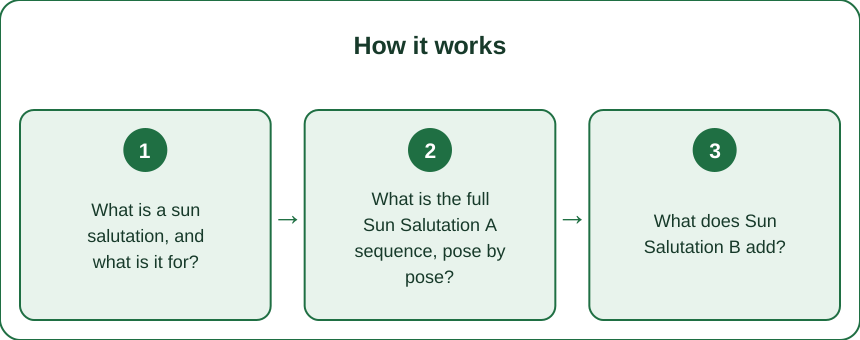
What is a sun salutation, and what is it for?
A sun salutation is a fixed sequence of poses linked to a breathing pattern, where each movement corresponds to one inhale or one exhale. The Sanskrit name, Surya Namaskar, translates roughly as “salute to the sun,” and the sequence was traditionally practiced facing east at dawn.
In modern practice it does three jobs:
It warms the body. Moving through flexion, extension, and weight-bearing on the hands raises core temperature and blood flow within a couple of rounds — much more effectively than static stretching. That is why nearly every vinyasa class opens with them.
It teaches breath-to-movement linking. This is the actual skill vinyasa is built on. The sequence is short and repetitive precisely so you can stop thinking about what comes next and start noticing the breath driving it.
It works as a complete short practice on its own. Five rounds of Sun Salutation A is a legitimate 10-minute session on a day when you have nothing else. It is the most-used answer to “I only have ten minutes.”
The two standard versions: Sun Salutation A is the foundational sequence, shorter and more accessible. Sun Salutation B adds two poses and repeats parts of the sequence, making it noticeably more strenuous. In an Ashtanga-influenced class you will typically do five rounds of A followed by three to five rounds of B.
Other lineages have their own variations, and none of them is the wrong one.
What is the full Sun Salutation A sequence, pose by pose?
Start standing at the front of your mat, feet together or hip-width, arms at your sides. This is Tadasana, mountain pose.
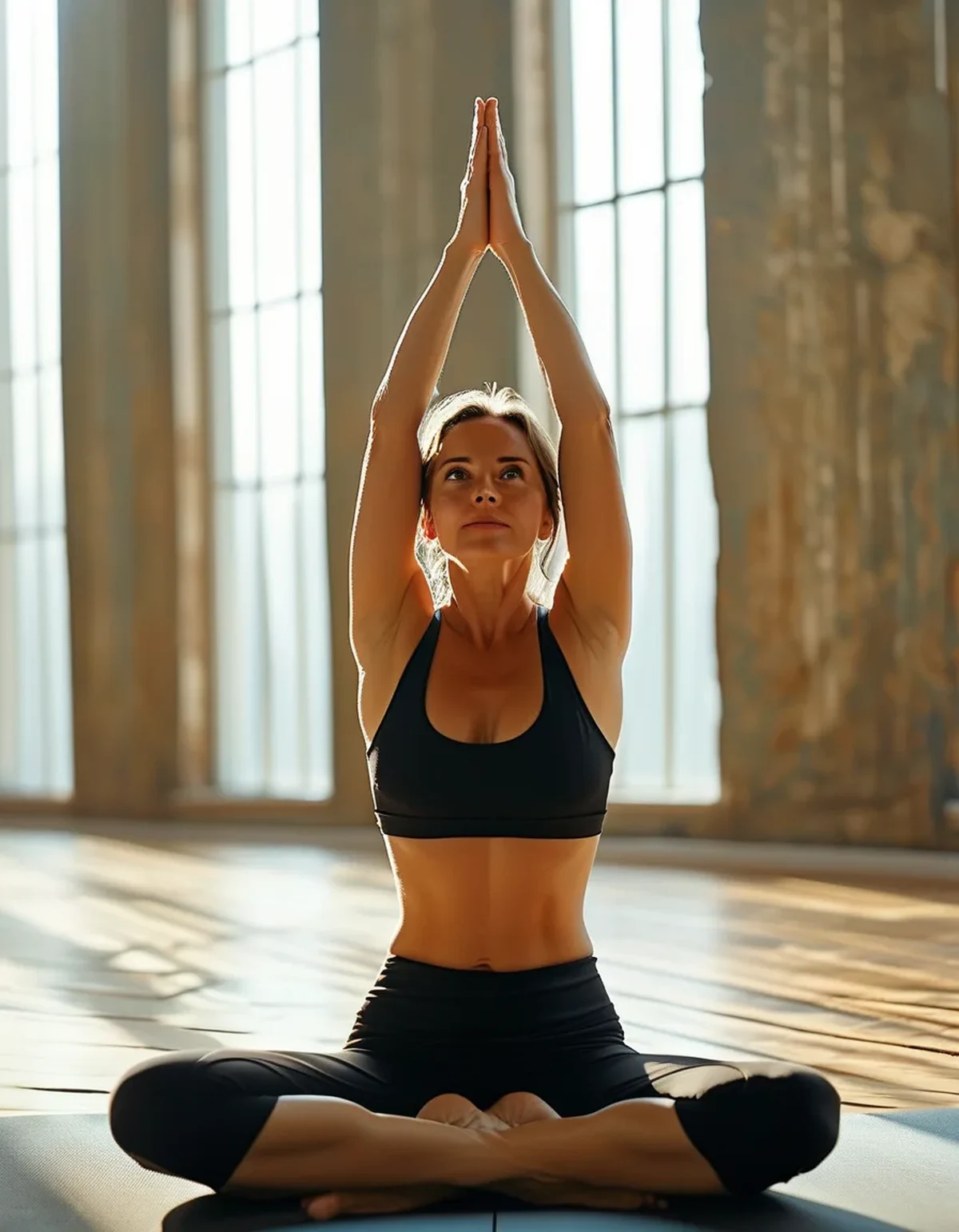
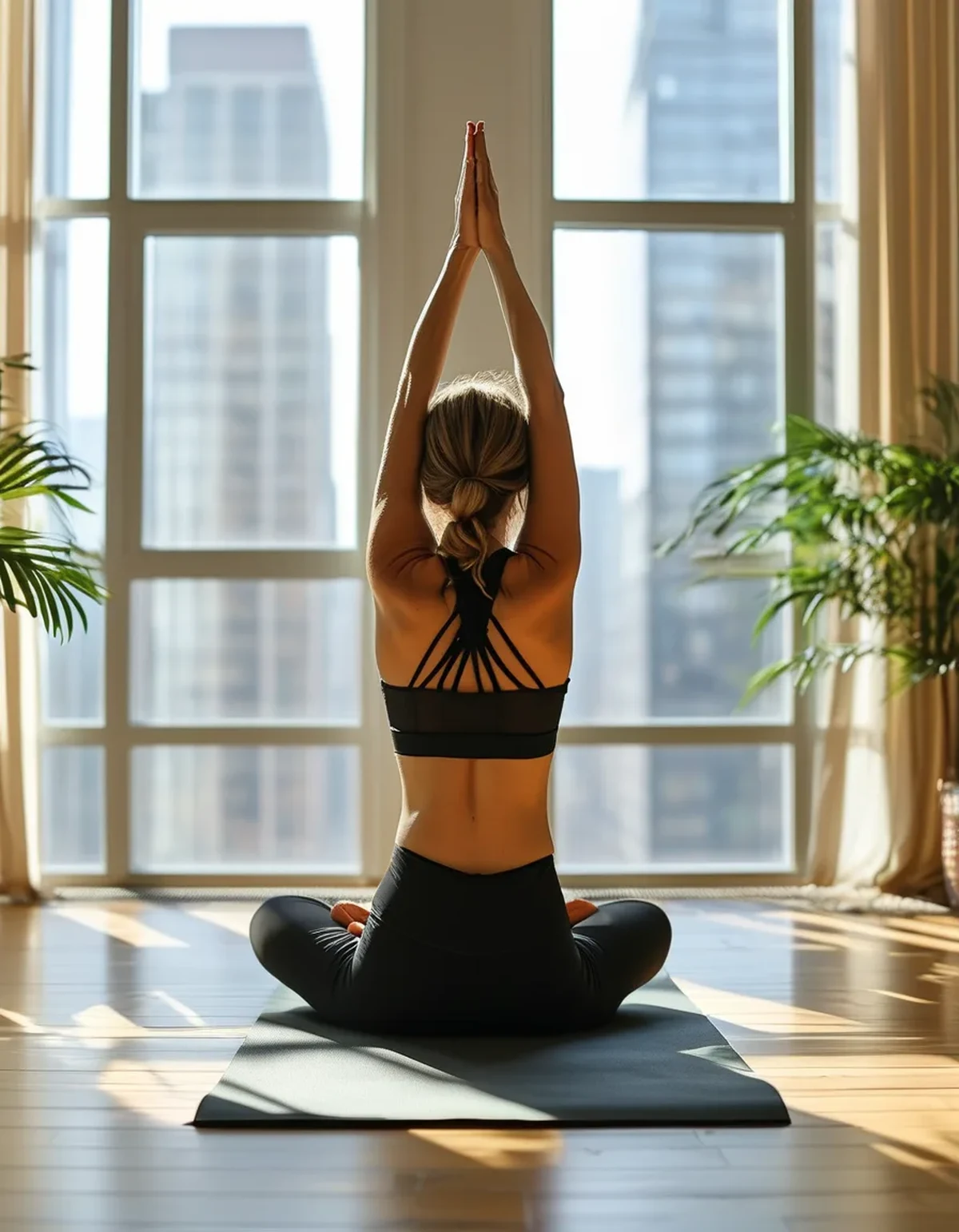
1. Inhale — Urdhva Hastasana (upward salute). Sweep both arms out and overhead. Palms can touch or stay shoulder-width. Look up only if your neck is comfortable.
2. Exhale — Uttanasana (standing forward fold). Hinge from the hips and fold forward, hands toward the floor. Bend your knees as much as you need to — this is the single most common place people force it. The fold should come from the hips, not from rounding the lower back.
3. Inhale — Ardha Uttanasana (halfway lift). Fingertips to shins or the floor, flatten your back into a long line, gaze slightly forward. This pose is what protects the fold that follows.
4. Exhale — step or jump back to Plank, then lower to Chaturanga Dandasana. Lower with elbows bent to about 90 degrees, hugging in toward the ribs rather than flaring out. Dropping the knees first is the correct modification here, not a lesser version — a bad chaturanga is the leading cause of shoulder trouble in yoga.
5. Inhale — Urdhva Mukha Svanasana (upward-facing dog). Roll over the toes, straighten the arms, lift the thighs off the floor, chest open. If that is too much, Bhujangasana (cobra) with the thighs down is the standard substitute.
6. Exhale — Adho Mukha Svanasana (downward-facing dog). Press back, hips up and back, heels reaching toward the floor without needing to touch it. Traditionally held for five breaths here.
7. Inhale — step or jump the feet forward to the halfway lift.
8. Exhale — fold to Uttanasana.
9. Inhale — rise all the way up to upward salute. Exhale — hands to heart or to your sides.
That is one round. Repeat five times.
What does Sun Salutation B add?
Sun Salutation B follows the same skeleton but inserts Utkatasana (chair pose) at the start and end, and Virabhadrasana I (warrior I) in the middle, on each side.
The sequence:
- Inhale — Utkatasana (chair). From standing, bend the knees deeply, sit the hips back as if into a chair, arms overhead. Weight in the heels.
- Exhale — forward fold.
- Inhale — halfway lift.
- Exhale — chaturanga.
- Inhale — upward-facing dog.
- Exhale — downward-facing dog.
- Inhale — right foot forward between the hands, back heel turned in about 45 degrees, rise into Virabhadrasana I (warrior I) with arms overhead, front knee over the ankle.
- Exhale — hands down, back to chaturanga.
- Inhale — upward dog. Exhale — downward dog.
- Repeat 7 through 9 on the left side.
- Inhale — step forward to halfway lift. Exhale — fold. Inhale — rise to chair. Exhale — stand.
B is roughly twice the work of A, mostly because of the two extra chaturangas per round and the deep sustained leg work in chair and warrior I. Three rounds of B is a real workout for most people, and it is entirely normal to do five rounds of A comfortably and find three rounds of B genuinely hard.
If B is too much, doing A with chair pose added — but skipping the warrior sequence — is a useful in-between step that nobody tells beginners about.
5 Mistakes People Make in Sun Salutations
Mistake 1: Moving at the speed of the room instead of the speed of your breath. The whole point of the sequence is one movement per breath. If you are rushing to keep up with a class and taking half breaths, you have lost the actual practice. Slow your movement to your breath, not the reverse. It is fine to be a beat behind everyone.
Mistake 2: Straight legs in the forward fold. Hamstring length varies enormously between people, and forcing a straight-legged fold rounds the lumbar spine under load. Bend the knees generously. The pose is a hip hinge; the knees are not the point.
Mistake 3: Chaturanga with the elbows flared and the chest dropped. The most common injury pathway in vinyasa. Elbows stay close to the ribs, shoulders stay above elbow height, and if you cannot control the lower, put your knees down. Repeating a poor chaturanga a hundred times a week is how shoulders get angry.
Mistake 4: Trying to get the heels down in downward dog. Heel contact depends on ankle and calf structure and is not a measure of anything. Prioritize a long spine and hips reaching up and back; bend the knees as much as needed to get there.
Mistake 5: Doing them cold and fast, first thing, on a stiff body. Sun salutations are the warm-up, but the first round should be the slowest and gentlest of the set. Round one is not a performance — it is reconnaissance. Most people go hardest exactly when their body is least ready.
If you have a wrist, shoulder, or lower back issue, or you are pregnant, several of these poses need specific modification — work with a teacher who can see you rather than adapting on your own. This is general information, not medical advice.
How should you actually practice them?
If you are brand new: do three rounds of Sun Salutation A, slowly, with knees down for chaturanga and cobra instead of upward dog. Take an extra breath anywhere you need one. Three careful rounds beats eight rushed ones by a wide margin.
As a standalone short practice: five rounds of A takes about eight to ten minutes at a reasonable pace and covers spinal flexion, extension, upper body loading, and hamstring work. This is the highest-value ten minutes in yoga.
As a warm-up before a longer session: three rounds of A, then two to three rounds of B, then move into standing poses. Your body will be genuinely warm.
As a morning routine: this is the traditional use, and it works well. Practice on a mostly empty stomach, move slowly for the first round, and expect the second and third rounds to feel dramatically better than the first. That improvement between rounds is the sequence doing its job, not you finally getting it right.
How long until it feels natural? Most people stop having to think about the order after about two weeks of near-daily practice, and that is when the actual benefit starts — because the attention moves from choreography to breath.
How many rounds is enough? Traditional practice runs to a set number, but three to five rounds of A gets nearly all of the warming benefit. More rounds build endurance and heat, not additional flexibility.
FAQ: Sun Salutation Questions, Answered
What is the difference between Sun Salutation A and B?
A is the base sequence: 9 movements around forward fold, chaturanga, upward dog, and downward dog. B adds chair pose at the beginning and end, plus warrior I on each side, which roughly doubles the length and effort per round.
How many sun salutations should I do?
Three to five rounds of A is a solid daily practice and captures most of the warming benefit. Traditional Ashtanga practice does five rounds of A and three to five of B before moving on.
Can beginners do sun salutations?
Yes, with two standard modifications: knees down for chaturanga, and cobra instead of upward-facing dog. Bend the knees freely in every forward fold. These are not lesser versions — they are the correct version until the strength is there.
Do sun salutations count as exercise?
Five rounds of A raises heart rate modestly and loads the upper body meaningfully; rounds of B do considerably more. They are a genuine warm-up and a light-to-moderate workout, but they are not a substitute for strength training or sustained cardio.
What time of day should I practice them?
Traditionally at sunrise, and mornings do suit the sequence well since it is designed to wake the body. Practically, whenever you will actually do it is the right time. Just move slowly in the first round if your body is cold.
TL;DR: A sun salutation is a short breath-linked sequence used to warm the body and teach breath-to-movement.
- Sun Salutation A is 9 movements: upward salute, fold, halfway lift, chaturanga, upward dog, downward dog, and back up.
- Sun Salutation B adds chair pose and warrior I on each side — roughly twice the work per round.
- One movement per breath is the whole practice. Slow to your breath rather than to the room.
- Bend your knees in every fold, and put the knees down in chaturanga until you can control the lower.
- Three to five rounds of A is a real practice and a complete ten-minute session on its own.
- The second round always feels better than the first — that is the sequence working, not you improving mid-practice.
Try three slow rounds tomorrow morning before anything else. Two minutes each, and you will notice the difference by round three.
See It in Motion
Seen here: High Waist Yoga Leggings with Side Pockets — shop it on bubblelime.com
Keep Reading
This article is for general informational purposes only and is not medical advice. It is not a substitute for professional diagnosis or treatment. Always consult a qualified healthcare provider about your individual situation, especially before making significant changes to your diet or exercise routine.