Why the Same Flow Feels Different on a Cold Mat
Quick Answer: A cold mat and a cool room change your practice in three specific ways: your hands and feet grip worse on a cold surface, your hamstrings and hips take roughly twice as long to open, and your breath rate rises slightly in cool air. Warm the room, extend the opening sequence to ten minutes, and expect your usual depth to arrive around minute fifteen rather than minute five.
The mat is the same mat. The sequence is the sequence you have done four times a week since May.
And yet the forward fold that has been comfortable all summer now stops six inches higher, and your hands are sliding forward in downward dog for the first time in months.
Three things changed, and none of them are your practice.
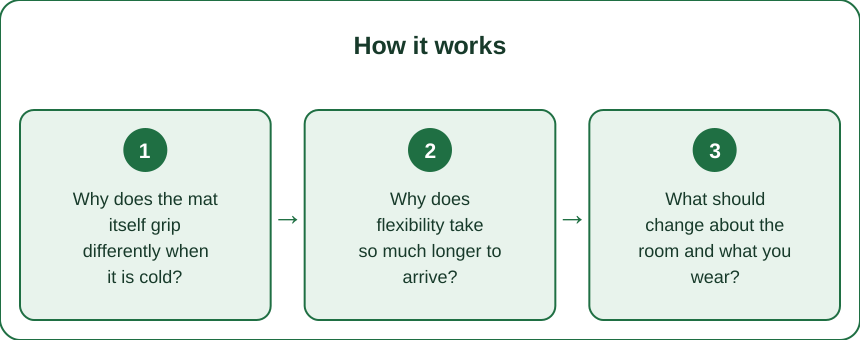
Why does the mat itself grip differently when it is cold?
This is the one people notice first and understand least.
Yoga mat surfaces — PVC, TPE, natural rubber, polyurethane — all rely on a combination of surface texture and a degree of tackiness to hold your hands and feet. That tackiness is a property of the polymer, and polymers get harder and less tacky at lower temperatures.
A natural rubber mat that grips beautifully at 22°C is measurably firmer and slicker at 15°C. Cork and polyurethane surfaces are less affected but not immune. If you practise on a floor that sits over a cold slab or in a room that has been unheated overnight, the mat can be several degrees below room temperature even after the air has warmed.
There is a second half. Your palms sweat less in cool air, and a small amount of moisture is what activates the grip on most mat surfaces — which is why a polyurethane mat feels slippery for the first five minutes and then locks in once you have warmed up. In a cool room that transition takes much longer or never fully arrives.
Practical fixes, in order of effectiveness:
- Unroll the mat twenty minutes before you practise so it can come up to room temperature. This alone solves most of it.
- Use a light mist of water on the mat surface before starting, if your mat is the type that grips better damp.
- Keep a small towel at the top of the mat for the first ten minutes rather than for the whole session.
- Do not chase grip with a new mat. The mat is fine. The room is cold.
Why does flexibility take so much longer to arrive?
Because muscle and connective tissue compliance is directly temperature-dependent, and the effect is larger than most people assume.
Warmer tissue deforms more readily and returns to length more efficiently. Cooler tissue is stiffer, transmits force differently, and produces protective muscle tension sooner in a stretch. This is not about being less flexible — your maximum available range has not changed. What has changed is how far into your range you can comfortably go on any given day, and how long it takes to get there.
The tissues most affected are the ones with the largest connective tissue component and the least blood flow at rest: hamstrings, hip flexors, the posterior chain generally, and the thoracic spine. These are, not coincidentally, the areas where people notice the seasonal change most.
Restructuring the practice for cool conditions:
- Extend the opening to ten minutes, roughly double a summer warm-up. Cat-cow, gentle sun salutations at half range, standing swings.
- Move continuously rather than holding early. Dynamic movement raises tissue temperature; static holds in a cool room do not, and can actually cool you further.
- Save the deep passive work for the end, when you are genuinely warm. A long pigeon or a seated forward fold at minute five is a very different proposition from the same shape at minute thirty-five.
- Accept a shallower peak. If your usual practice ends with a deep backbend, the cool-season version of that pose is a smaller one, and that is correct rather than a failure.
The rough rule: your usual depth arrives around minute fifteen, not minute five. Structuring around that fact removes most of the frustration.
What should change about the room and what you wear?
Small environmental changes have disproportionate effects here.
Warm the room before, not during. Turning the heating on when you start means you spend the first fifteen minutes — the part that most needs warmth — in a cold room. Twenty minutes ahead is the useful timing.
Close the window you have had open since June. Air movement over damp skin is the fastest way to lose heat, and you are barely moving air yourself in a slow practice.
Layer for the beginning, not the middle. A long-sleeve top and socks for the first ten minutes, removed as you warm, is far better than practising cold in a vest because that is what you wear in summer.
Socks with grip, or no socks. Regular socks on a mat are genuinely unsafe in standing poses. If your feet are cold enough to need covering, grip socks exist for exactly this.
Consider where the mat sits. Moving it two metres away from an exterior wall or a draughty door changes the local temperature more than you would expect.
Mind the end of practice. Savasana in a cool room is where you lose all the heat you just built, and lying still on a cold floor is genuinely unpleasant. A blanket over you for the final rest is not indulgence, it is the difference between finishing the practice and cutting it short.
Myth vs Fact: Cold Weather Practice
Myth: You lose flexibility in the winter. Fact: Your available range is largely unchanged; your access to it on a cold morning is reduced. People who keep practising through winter usually find their range in spring is where they left it in autumn.
Myth: You should hold stretches longer when you are stiff. Fact: Holding longer in cold tissue increases protective tension rather than reducing it. Moving more, for longer, before you hold anything is the more effective response.
Myth: A hot room is the answer. Fact: Externally heated flexibility is real but temporary, and it can allow you into ranges your tissue is not otherwise prepared to control. A warm room is helpful; a hot one is a different practice with different trade-offs.
Myth: If the mat is slipping you need a better mat. Fact: Most seasonal slipping is a cold surface plus dry palms. The same mat that felt perfect in July has not degraded in six weeks. Warm it up first, then judge.
FAQ: Cool Season Yoga Questions, Answered
Should I switch to a different style of practice in autumn?
Not necessarily, but many people naturally shift toward slower, longer, more grounding sequences as the season changes and find that pleasant rather than limiting. The main structural change worth making is moving deep passive work from early in the session to the end.
How long does it take to adapt to the cooler room?
Two to three weeks of consistent practice is typically enough for the difference to stop feeling dramatic, partly through genuine acclimatisation and partly because you stop expecting summer depth at minute five.
Is it worth practising in the evening instead?
If you have the flexibility to choose, yes — body temperature peaks in the late afternoon and early evening, which is genuinely the easiest window for range of motion. Morning practice has other benefits worth keeping; just budget a longer warm-up for it.
TL;DR:
- Cold mats grip worse because the surface polymer stiffens and your palms sweat less
- Tissue compliance is temperature-dependent, so your usual depth arrives around minute fifteen rather than minute five
- Double the opening sequence and move continuously rather than holding early
- Warm the room twenty minutes before, layer for the first ten minutes, and use a blanket in savasana
- Move deep passive work to the end of the session, not the beginning
Nothing about your practice has gone backwards. You are doing the same sequence in a room that is asking for a different pacing, and the adjustment is entirely in the first fifteen minutes.
See It in Motion
Seen here: Bootcut Capri Yoga Pants with Pockets — shop it on bubblelime.com
Keep Reading
This article is for general informational purposes only and is not medical advice. It is not a substitute for professional diagnosis or treatment. Always consult a qualified healthcare provider about your individual situation, especially before making significant changes to your diet or exercise routine.