A Yoga Flow for the First Cold Morning of the Season
Quick Answer: Cold mornings reduce muscle and connective tissue extensibility, so a flow that felt fine in August feels stiff and forced in late September. The fix is to invert the usual order: start with 5 to 8 minutes of small joint-warming movement before any lengthening, keep the first standing poses shorter than usual, and save deep hip and hamstring work for the end rather than the middle.
Most people respond to the first cold morning by pushing harder into the same poses. That is exactly the wrong adjustment.
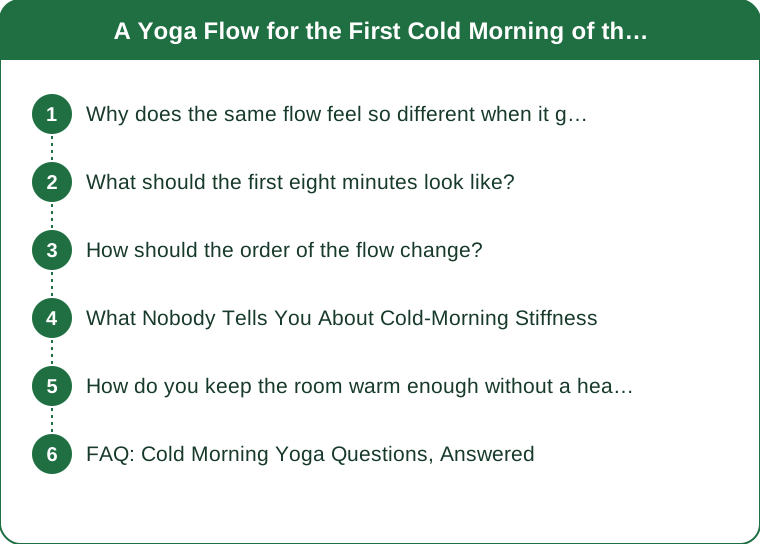
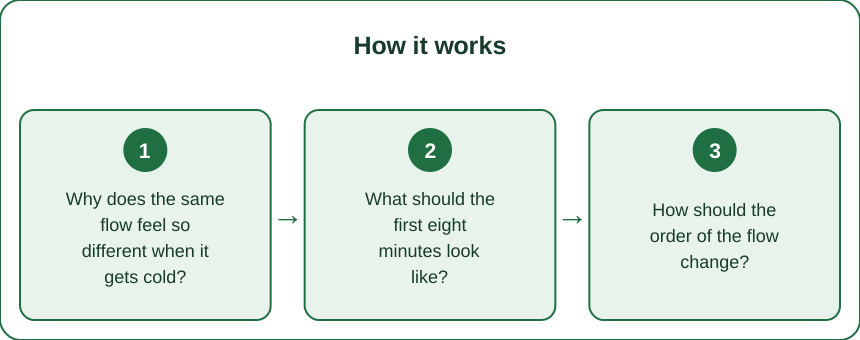
Why does the same flow feel so different when it gets cold?
Because tissue behavior is genuinely temperature-dependent, and the effect is larger than most people assume.
Muscle and tendon are viscoelastic - their resistance to stretch depends on both how far and how fast you stretch them, and on temperature. As tissue temperature drops, viscosity rises and the tissue resists deformation more.
Intramuscular temperature in the morning after a night in a cool room can sit meaningfully below the temperature at which those tissues stretch comfortably. Synovial fluid in joints is also more viscous when cold, which is a large part of the stiff-joint feeling in the first few minutes of movement.
The practical result: the same pose at the same depth generates more tension in cold tissue. Your body reads that increased tension as a stretch signal, the protective reflex fires earlier, and you feel restricted.
This is not a loss of flexibility. Your range of motion has not changed. The temperature at which you are trying to access it has.
What should the first eight minutes look like?
Small, repeated, non-loaded movement through the joints you are about to ask for range from. Not stretching.
A sequence that works, done seated or on hands and knees:
- Wrist and ankle circles, 10 each direction. Distal joints warm fastest and it costs almost nothing.
- Cat-cow, 12 slow rounds. Segmental spinal movement moves synovial fluid and raises local temperature without loading anything.
- Thread the needle, 5 each side, held only 2 to 3 breaths. Short holds, not long ones.
- Hip circles on hands and knees, 8 each direction. This is the single most valuable one for a cold morning, because the hip is deep, well-insulated, and slow to warm.
- Standing arm swings and gentle torso rotations, 30 seconds.
The principle is movement through range, not holding at end range. Repetition raises tissue temperature; holding does not.
Eight minutes sounds like a lot when your whole practice is twenty. It is worth it, because the remaining twelve minutes will be more productive than twenty cold ones would have been.
How should the order of the flow change?
Move the demanding work later and shorten the early holds.
A warm-weather morning flow can go into a lunge or a forward fold within the first three minutes and it feels fine. A cold-morning flow should treat those as mid-practice poses, not opening poses.
A reasonable reordering:
Minutes 0-8: joint circles, cat-cow, gentle spinal movement as above.
Minutes 8-14: standing poses with short holds - 3 to 4 breaths rather than 6 to 8. Mountain, gentle sun salutation variations with the knees soft, low lunge without pressing deep, warrior II.
Minutes 14-22: the poses that need range - deeper lunges, pigeon or a supine figure-four, hamstring work, twists. This is where the tissue is finally warm enough to respond well.
Minutes 22-25: brief stillness or savasana, kept short because a cool room makes long stillness genuinely uncomfortable and you will cool down fast.
One detail that helps more than it should: keep socks on for the first half. Feet are the fastest to cool and cold feet make balance poses noticeably harder.

What Nobody Tells You About Cold-Morning Stiffness
The stiffness you feel at 6am is not primarily temperature. It is fluid.
Overnight, in the absence of movement and with the body horizontal, fluid redistributes. The intervertebral discs rehydrate and expand during sleep - you are measurably taller in the morning, typically by 1 to 2 centimeters - and that expansion increases pressure and reduces spinal flexibility.
Which means deep spinal flexion in the first hour after waking is loading a disc at its most hydrated and least compliant. This is why forward folds and deep seated twists feel worst first thing, and why they feel dramatically easier at 6pm.
The practical implications:
- Move upright first. Ten minutes of standing or walking allows some fluid to redistribute before you ask the spine to flex.
- Bend the knees generously in early forward folds. This takes load off the spine and puts the stretch where you want it.
- If a pose feels significantly worse in the morning than in the evening, that is normal and not a sign of a problem.
Combine this with the temperature effect and you have the full explanation for why the first cold morning of the season feels like your practice regressed by six months. It did not.
How do you keep the room warm enough without a heated space?
Three cheap adjustments, in order of effectiveness.
Layer and remove. Start in a long-sleeve layer and leggings, remove the layer around minute ten when you begin generating heat. This is more effective than heating the room, because you are insulating the tissue directly.
Practice on a rug or add a blanket under the mat. A mat on a cold hard floor conducts heat out of your hands, feet, and any part of you touching it. An extra insulating layer underneath makes a genuine difference to how the first ten minutes feel.
Move to the warmest room, and away from windows. Radiant cooling from a cold window is significant if you are within a meter or two of it. The corner of a room is usually the warmest spot.
One timing consideration for the season: as mornings get darker through autumn, many people find the same practice easier if they simply move it later - an hour of being awake and upright does more for morning stiffness than any warm-up sequence. If your schedule allows shifting the practice to mid-morning on the coldest days, that is the most effective adjustment available.
FAQ: Cold Morning Yoga Questions, Answered
Am I losing flexibility as the weather cools?
No. Your available range is unchanged; the temperature at which you are accessing it dropped. Measured flexibility typically returns immediately once tissue is warm, which you can verify by testing the same pose after a hot shower.
Should I take a hot shower before practicing?
It genuinely helps and is a legitimate shortcut on very cold mornings. A warm shower raises superficial tissue temperature and reduces the joint-fluid stiffness meaningfully. It is not a substitute for movement-based warm-up, but it stacks well with a shortened one.
Is it dangerous to stretch cold?
Mostly it is just ineffective rather than dangerous, since the protective reflex stops you before damage in almost all cases. The real risk comes from forcing past that signal - pushing hard into a cold hamstring or a cold hip is where strains happen. If a stretch produces sharp or pinching sensation rather than broad tension, come out of it. This is general information, not medical advice.
TL;DR:
- Cold tissue resists deformation more, so the same pose generates more tension - your flexibility has not changed, its access temperature has.
- Spend the first 8 minutes on repeated joint movement rather than holding stretches.
- Reorder the flow: short standing holds first, deep hip and hamstring work in the last third.
- Morning stiffness is also disc hydration - move upright first and bend the knees in early forward folds.
- Layer up and insulate under the mat rather than trying to heat the room.
The first genuinely cold morning is coming for most of us in the next few weeks. Adjust the order rather than the effort and the practice keeps working. This is general information, not medical advice.
See It in Motion
Seen here: Super High Waist Embossed Yoga Leggings with Inner Pocket — shop it on bubblelime.com
Keep Reading
This article is for general informational purposes only and is not medical advice. It is not a substitute for professional diagnosis or treatment. Always consult a qualified healthcare provider about your individual situation, especially before making significant changes to your diet or exercise routine.