Does the Order of Poses in a Yoga Flow Actually Matter?
Quick Answer: Yes — pose order matters because your body needs to warm up before deeper stretches or holds are safe and effective, and certain poses prepare joints and muscles for the ones that follow. A thoughtful sequence produces more benefit and less injury risk than a random string of poses.
It’s tempting to just do whatever poses come to mind in a flow, especially at home without a teacher guiding sequence. But the order isn’t arbitrary tradition — it reflects how your body actually needs to be prepared for what comes next.
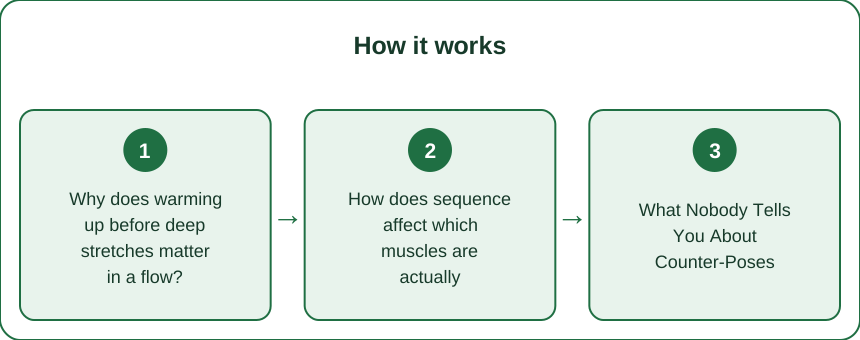
Why does warming up before deep stretches matter in a flow?
Cold muscles and connective tissue are less pliable and more prone to strain when pushed into a deep stretch immediately. A flow that opens with gentle, dynamic movement (cat-cow, gentle twists) before moving into deeper holds gives tissue time to warm and lengthen safely.
Skipping straight to a deep hip opener or deep backbend without this buildup is one of the more common ways people strain something during an otherwise gentle practice.
How does sequence affect which muscles are actually available to use?
Certain poses activate muscle groups that later poses depend on — poses that engage the core and glutes earlier in a sequence make balance poses later in the flow noticeably more stable, because those stabilizing muscles are already switched on.
A sequence that jumps straight into a challenging balance pose cold, without this activation, often feels wobblier than the same pose attempted later in a well-built flow — that’s about muscle readiness, not skill.
What Nobody Tells You About Counter-Poses
Many effective sequences deliberately follow an intense pose with a counter-pose that moves the spine or joints in the opposite direction — a deep backbend followed by a gentle forward fold, for instance. This helps release tension the first pose created and returns the body to a neutral state before moving on.
Skipping counter-poses entirely, especially after intense backbends or twists, can leave residual tightness that carries into the rest of the flow or even into the next day.
Is there a simple structure to follow when building your own flow?
A reasonable general structure: gentle warm-up movement (3-5 minutes), then moderate strength and mobility poses, then the flow’s peak or most challenging poses, then counter-poses, then a cool-down and final relaxation. This mirrors how most instructor-led classes are actually built, even when it isn’t obvious from the student’s side.
For a home practice, this doesn’t need to be complicated — even a rough mental checklist (warm up, build up, peak, wind down) produces a noticeably more effective and comfortable flow than random pose selection.
FAQ: Yoga Sequencing Questions, Answered
Can you skip the warm-up if you’re short on time?
Shorten it rather than skip it entirely — even 60-90 seconds of gentle movement before anything deep meaningfully reduces strain risk compared to zero warm-up.
Does sequence matter as much for a gentle restorative flow?
Less so — restorative practice relies less on building heat and activation, though a rough warm-to-cool arc still helps the body settle rather than jumping straight into a long passive hold cold.
Is it fine to follow different YouTube sequences each day with no consistent structure?
Yes, as long as each individual sequence follows a sensible warm-up-to-cool-down arc — variety between days is fine; the structure within a single session is what matters most.
TL;DR:
- Warm up before deep stretches — cold tissue is more strain-prone
- Activation poses early make balance poses later noticeably more stable
- Counter-poses release what the peak pose created — don’t skip them
- A rough warm-build-peak-cool structure beats random pose selection
You don’t need a teaching certification to sequence well at home — just a mental checklist of warm up, build, peak, cool down.
See It in Motion
Seen here: Bootcut Yoga Pants with Side Pockets — shop it on bubblelime.com
Keep Reading
This article is for general informational purposes only and is not medical advice. It is not a substitute for professional diagnosis or treatment. Always consult a qualified healthcare provider about your individual situation, especially before making significant changes to your diet or exercise routine.